
Work, Energy and Power
MDCAT • Physics
270 MCQs — Click "Reveal" to see the correct answer
Build a test-
1UHS MDCAT 2008
The escape velocity corresponds to ____ energy gained by the body, which carries it to an infinite distance from the surface of earth.
-
2UHS MDCAT 2008
Work done on a body equals change in its _______ energy.
-
3UHS MDCAT 2009
A body of mass 6 g falls under action of gravity. At initial position 'A' its P.E. is 480 J and K.E. is 0 J. During its downward journey at point 'B' its energies will be (g = 10 ms-2)
-
4UHS MDCAT 2009
Solar energy at normal incidence outside the earth's atmosphere is about:
-
5UHS MDCAT 2009
If a certain force acts on an object and changes its kinetic energy from 65 J to 130 J, then work done by the force will be:
-
6UHS MDCAT 2010
On a clear day at noon, the intensity of solar energy reaching the earth’s surface is about:
-
7UHS MDCAT 2010
Value of escape velocity for the surface of the earth is 11 km/sec. Its value for surface of the moon is:
-
8UHS MDCAT 2010 FMDC MDCAT 2024 (Reconduct) PMDC MDCAT 2020
Which one of the following is a non-conservative force?
-
9UHS MDCAT 2010
If velocity is double, then:
-
10UHS MDCAT 2015
Strain energy in deformed energy is stored in the form of:
-
11UHS MDCAT 2017
If mass 'm' is dropped from height 'h' vertically, 'f' is the force of friction during downward motion and 'v' is the velocity at bottom, following will hold:
-
12UHS MDCAT 2017
Work done will be zero if angle between force and displacement is:
-
13UHS MDCAT 2017
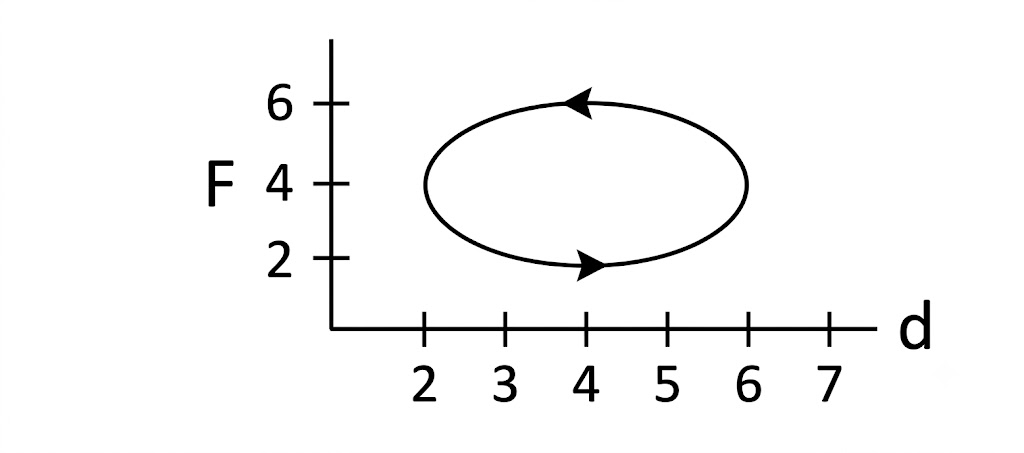
In the shown figure, calculate the total work done : -
-
14UHS MDCAT 2017 (Reconduct)
An object of mass 2 kg is lifted vertically through a distance of 1.5 m. The work done in process is:
-
15UHS MDCAT 2017 (Reconduct)
At what angle will work be maximum?
-
16UHS MDCAT 2017 (Reconduct)
Which one of the following is a greater work?
-
17UHS MDCAT 2018
A stone of mass 2.0 kg is dropped from a rest position 5.0 m above the ground. What is its velocity at a height of 3.0 m above the ground?
-
18UHS MDCAT 2019
Which of the following statement shows that no work is done?
-
19UHS MDCAT 2019
An automobile is moving forwards with uniform velocity due to the force exerted by its engine. If the force is doubled with the velocity remaining constant, what happens to its total power?
-
20UHS MDCAT 2019
The range of the projectile depends upon the velocity of the projection and the angle of the projection i.e. 45. For a fixed velocity, when the angle of projection is larger than 45. Which of the following is correct?
-
21UHS MDCAT 2022
A particle of mass m at rest is acted upon by a force P for time t. Its kinetic energy is:
-
22UHS MDCAT 2022
Ignoring details associated with friction, extra forces exerted by arm and leg muscles, and other factors, we can consider a pole vault as the conversion of an athlete's running kinetic energy to gravitational potential energy. If an athlete is to lift his body 5m during a vault, what speed must he have when he plants his pole?
-
23UHS MDCAT 2022
A long spring, when stretched by a distance x, has potential energy V. On increasing the stretching to nx, the potential energy of the spring will be:
-
24UHS MDCAT 2023
A fisherman lifts a fish of mass 250 g from rest through a vertical height of 1.8 m. The fish gains a speed of 1.1 m/s. What is the energy gained by the fish?
-
25UHS MDCAT 2023
Two bodies with kinetic energies in the ratio of 4: 1 are moving with equal linear momentum. The ratio of their masses is:
-
26UHS MDCAT 2023
The work done by a variable force can be found by dividing the:
-
27UHS MDCAT 2024
Work-done is equal to:
-
28UHS MDCAT 2024
An electric motor is used to lift the weight of 2.0N through a vertical distance of 100 cm in 4 sec. What is the power output of the motor?
-
29UHS MDCAT 2024
When a force of 1N displaces its point of application by 1m in the direction of the force, the work done is
-
30UHS MDCAT 2024
Which of the following is a non-conservative force?
-
31UHS MDCAT 2024
In an elastic collision, the total kinetic energy
-
32PMDC MDCAT 2025
Earth receives large amount of energy directly from:
-
33PMDC MDCAT 2025
If P is the momentum of an object and m is its mass, then its kinetic energy is:
-
34PMDC MDCAT 2025
A 0.5 kg ball moving at 6 m/s has kinetic energy
-
35PMDC MDCAT 2025
The work done by the gravitational force on an object as it moves from a reference level to a higher point is:
-
36
If the K.E of a body becomes four time of the initial value, then new momentum will:
-
37
If momentum is increased by 20% then K. E increase by:
-
38
The atmosphere is held to the earth by:
-
39
Two bodies of masses m1 and m2 have equal momentum their kinetic energies E1 and E2 are in the ratio:
-
40
Escape velocity on the surface of the earth is 11.2 kms-1. If the mass of the earth increases to twice its value and the radius of the earth become half the escape velocity is:
-
41
The force constant of a wire is k and that of the another wire is 3k when both the wires are stretched through same distance, if work done are W1 and W2, then
-
42
You push a heavy crate down a ramp at a constant velocity. Only four forces act on the crate. Which force does the greatest magnitude of work on the crate?
-
43
If the speed of an object is tripled, its kinetic energy is increased by:
-
44
Conventional method of energy extracted is:
-
45
Which the following source of energy is not a fossil fuel?
-
46
When velocity of body of mass 10 kg is increased from 2 ms-1 to 8 ms-1 then the work done of the body is:
-
47
What is the value of potential energy of a body at the height where the value of 'g' is zero?
-
48
Absolute potential energy of a body at the surface of the earth is:
-
49
What is the power of an electric motor when it consumes energy of 9 x 10³ J in 3 s?
-
50
If the velocity is doubled then the K.E of the body will be:
-
51
The area under a curved force and displacement graph shows:
-
52
A man pulling a bag with force of 15 N at angle 60° with horizontal plane. If bag convers a distance of 10 m, then work done by the man is:
-
53
When the applied force and covered displacement are parallel to each other than work done of the body is:
-
54
An engine pulls a car of mass 1500 kg on a level road at a constant speed of 5 ms-1. If the frictional force is 500 N, what power does the engine generate?
-
55
An elevator's motor produces 3000 W power. The speed with which it can lift a 1000 kg load is:
-
56
An engine pumps out 40 kg of water in one second. The water comes out vertically upwards with a velocity of 3 ms-1. What is the power of engine in kilowatt?
-
57
An engine pumps up 100 kg of water through a height of 10 m in 5s. Given that the efficiency of the engine is 60%, what is the power of the engine? (Take g = 10 ms-2)
-
58
A man M1 of mass 80 kg runs up a staircase in 15 S. Another man M2 also of mass 80 kg runs up the samestaircase in 20 S. The ratio of the power developed by them will be:
-
59
The power output of a lamp is 6W. How much energy does the lamp give out in 2 minutes?
-
60
A mass hangs on a string fixed at point P. It starts from position 1 and swings to the furthest position on the opposite side, position 2. It then oscillates several times with decreasing amplitude before ending at position 3.Where does the ball have the most kinetic energy?
-
61
To travel at a constant speed, a car engine provides 24 kW of useful Power. The driving force on the car is 600 N. At what speed does it travel?
-
62
The time taken by an engine of power 10 kW to lift a mass of 200 kg to the height 440 m is
-
63
A 500N force is applied on an object and it moves with velocity 10 ms-1. If value of power is 2500 watt. Then what will be the angle between force and displacement
-
64
In the presence of air friction, the relation for free falling body is
-
65
In freely falling system, if potential energy is equal to kinetic energy. Then force of friction of air will :
-
66
If 10 kg mass is dropped from a certain height, hits the ground with speed 10 ms-1. The height will be
-
67
You lift a suit case from the floor and keep it on a table. The work done by you on the suitcase does not depend on.
-
68
A stone is thrown up from the surface of earth when it reaches at maximum height. Its total energy is equal to
-
69
A ball is thrown vertically upwards. Neglecting air resistance, which statement is correct?
-
70
The bricks, each 6.0 cm thick and mass 1.5 kg, lie flat on a table. How much work is required to stack them one on the top of another?
-
71
Energy stored in the spring of watch is:
-
72
A body is falling from a height h. After it has fallen a height h/2 , it will possess:
-
73
A body is dropped from 1000m height, if its potential energy is 8 x 10⁸ J. What will be its velocity on reaching the ground?
-
74
A truck and a car are moving with equal velocity. On applying brakes, both will stop after a certain distance, then?
-
75
When force and displacement are in the same direction, the kinetic energy of the body:
-
76
A ball is dropped from a height as shown.Ignoring the effects of air resistance, the total energy is:
-
77
The kinetic energy acquired by a body of mass m is travelling some distance s, starting from rest under the actions of a constant force, is directly proportional to
-
78
A bomb of mass 30 kg at rest explodes into two pieces of masses 18 kg and 12 kg. The velocity of 18 kg mass is 6 m s-1. The K.E of other mass is
-
79
Kinetic energy of a body moving with speed of 10 m s-1 is 30 J. If its speed becomes 30 m/s its K.E will be:
-
80
If momentum of a moving object is doubled then its kinetic energy will be:
-
81
The velocity and momentum of a moving body are 10,000 cm s-1 and 10,000 g cm s-1 respectively. The K.E will be:
-
82
The bodies of one kg and four kg mass have same kinetic energy. The ratio in their momenta will be:
-
83
One erg is equal to:
-
84
What will be the ratio of kinetic energies of alpha particle and proton if their linear momentum will be same?
-
85
A tennis ball is dropped on to a horizontal surface. As the ball bounces up and down, the height of each bounce gradually decreases. During the motion:
-
86
A person is holding a bucket by applying a force of 10N. He moves a horizontal distance of 5m and then climbs up a vertical distance of 10m. Find the total work done by him?
-
87
The diagram shows a flight of stairs. How much useful work is done by a person weighing 600 N when climbing the stairs?
-
88
A force F acting on an object varies with distance x as shown in fig. The work done by the force in moving the object from x = 0 to x = 6 m is:
-
89
A person holds a bucket of weight 60 N. He walks 7 m along the horizontal path and then climbs up a vertical distance of 5 m. The work done by the gravity is:
-
90
A body travels displacement of 10 m by force of 5 N If work done is 25 J then angle between F and d is
-
91
A force of 3i +2j+4k N gives displacement of 10 jm. The work done is:
-
92
A person walks 2 m with an acceleration of 5 m s-2, holding an object of mass 2 kg. The net work done on the object is
-
93
If a mass of 5 Kg is lifted upto 5m height, what will be the work done against the gravitational field:
-
94
A man pushes a wall with 50 (N) and it displaces it zero (m). The work done is:
-
95
At what angle the work done will be half of its maximum value:
-
96
A body with a mass 100 g has a velocity → v =(2i +4j) m/s at a certain instant of time. Its kinetic energy is:
-
97
A person "X" of 75 kg walks up a staircase in 15 s. Another person "Y" of mass 60 kg walks up the same staircase in 12s. The ratio of the power generated by "X" to that by "Y" is:
-
98
The height of the dam is 20 m at a hydroelectric power plant. How many of kg of water must fall per second on the blades of a turbine to generate one mega watt of electrical power? (g=10 m/s2)
-
99
An electric motor car has a rating of 500 watt. How much energy per minute is delivered by it?
-
100
A 5 kg block is moved from the rest through a distance of 4 m along the x-direction. A force equal to 20 N acts on it. If the block acquires a K.E. equal to 40 J, what is the angle the force makes with x—axis?
-
101
A rubber ball is dropped from a height of 5 m on a planet where the acceleration due to the gravity is not known. On bouncing it rises to 1.8 m. The ball loses its velocity on bouncing by a factor of:
-
102
A body is allowed to fall freely under gravity from a height of 12 m. It loses of 25% of its energy when it first hits the ground. To what height will it rise after the first impact with the ground?
-
103
During rainfall, a certain drop of radius "r" falls through a height "h" above the ground. The work done by the gravitational force is proportional to the:
-
104
A ball, starting at point X, rolls down the hill shown in the diagram. At which point does the ball have half of its maximum kinetic energy? (Ignore friction)
-
105
A 50 kg body is accelerated from rest to 20 m/s in 10s. What is the amount of work done?
-
106
Work done against gravity in lifting a 5 kg box through a distance of 1.5 m is (g=10 ms-2):
-
107
A person with mass 60 kg climbs the stairs to the first floor 10 m above the ground in 20 s. The power developed by him is: (g = 10 m/s2)
-
108
A crane can raise a body of mass 100 kg vertically upward with a speed of 5 m/s. The power of its engine is (g= 10 m/s2):
-
109
A toy box is pushed along a horizontal floor through 2 m by means of a force equal to 10 N directed at an angle of 30° to the vertical. Total work done is:
-
110
A body is constrained to move in the y-direction. It is subjected to a force (−2i+15j+6k) Newton. The work done by this force in moving the body through a distance of 10 m in positive y-direction is:
-
111
A force F= 6i + 2j - 3k acts on a particle and produces a displacement d = 2i -3j+xk, what is the value of "x". If work done is zero?
-
112
The amount of work done is pumping water out of a cubicle vessel of height 1 m is: (g= 10 m/s2)
-
113
A person carries a load of 15 kg of bricks to the top of building 10 m high. The work done is: (g = 10 m/s²)
-
114
A2 kg block is thrown upward from a point 20m above Earth's surface. At what height above Earth's surface will the gravitational potential energy of the Earth-block system have increased by 500 J? (g = 10 m/s2)
-
115
Which of the following bodies has the largest kinetic energy?
-
116
A body of mass 1.0 kg drops from the top of a tower of height 50 m. What will be its K.E. 10 m below the top?
-
117
A child is revolving a tiny 10g stone, tied at one end of a string, in a vertical loop of 2m diameter. If the stone completes 100 revolutions in 1 second, the work done on it will be:
-
118
Object "A" has half the mass of object "B". If the two objects have equal momentum, then K.E. of object "A". in terms of K.E. of object "B" will be:
-
119
Initially, four identical uniform blocks, each of mass "m" and thickness "h", are spread on a table.How much work is done on the blocks in stacking them on top of one another?
-
120
Which is the biggest unit of energy:
-
121
Power can be defined as the dot product of:
-
122
The power is one kilowatt if work is done at the rate of:
-
123
The average power and instantaneous power become equal if work is done at:
-
124
If a body of mass 2kg is raised vertically through 2m, then the work done will be:
-
125
Which of the following type of force cannot do work on which it acts?
-
126
An object of 5 kg is pulled horizontally by a force of 50 N through a displacement of 10m. The work done by gravity is:
-
127
In 10 seconds, the elevator picks a weight of 1000 N over a distance of 10 m at a constant velocity. Its power is:
-
128
A man of mass 50 kg jumps to a height of 1 m. His potential energy at the highest point is (g = 10 m/s2):
-
129
A 40 N object is released from a height of 10 m. Just before it hits the ground, its kinetic energy, in joules is: (ignoring air friction)
-
130
Proton, electron, neutron and α-particle have same momentum. Which of them have highest K.E?
-
131
A force "F" acts on a body at an angle of 60° with the horizontal and moves it 10 m in horizontal direction. The effective component of the force which performs work is:
-
132
A ball whose kinetic energy is "E", is thrown at an angle of 45° with the horizontal. Its kinetic energy at the highest point of its trajectory will be:
-
133
If a power of 1 kW is maintained for 1 sec, then work done is equal to:
-
134
A ball of mass "m" is dropped from a height "h" above the ground. What is the velocity of the ball when it loses half of its initial potential energy?
-
135
A1 kg ball changes its velocity from 6 m/s to 2 m/s. What are the changes in the kinetic energy of the ball?
-
136
Two spherical bodies of identical diameter weighing 2 kg and 5 kg respectively are allowed to fall freely from the top of a tower at the same time. When they are 1.5 m above the ground, they will have the same value of:
-
137
A body builder lifts a 250 kg block from the ground to a height of 2 m in 2.5 s. The average power generated is: (Take g=10 m/s2)
-
138
Two bodies of masses 1kg and 2kg have the same momentum. The ratio of their K.E is:
-
139
A 10 kg bomb explodes into two pieces of masses 6 kg and 4 kg. The velocity of 4 kg mass is 12 m/s. What is the kinetic energy of the other mass?
-
140
A body of mass 40 kg, is acted upon by a constant force equal to 4 N over a distance of 2 m. What is the kinetic energy of acquired by the body?
-
141
A particle of mass "m" accelerates uniformly from rest to a speed "v" in "t" seconds. What is the average power delivered?
-
142
If the linear momentum changes by 10%, the kinetic energy will change by
-
143
A field is said to be conservative if:
-
144
The F-d graph for an object is a straight line with positive slope. If the height and width of the graph are 4 units and 2 units respectively, the work done on the object is:
-
145ETEA MDCAT 2016
An object of mass 1 g is whirled in a horizontal circle of radius 0.5m at a constant speed of 2m/s. The work done on the object during one revolution is:
-
146
To pump up 2400 kg of water up 74.6 m in 5 minutes, the required in horse power is:
-
147
If you weigh 500 N and in 5 seconds you can run up a flight of stairs consisting of 40 steps, each 15 cm high, what is your power?
-
148
A body is falling freely under gravity from point "A" to point "B".The energy of the body at the point "C" (ground level) is:
-
149
A 100 kg car starting from rest runs down a 30° slope. If the total length of the slope is 20 m, the speed of the car at the bottom, ignoring friction, is:
-
150
A man carries a 1 kg suitcase horizontally across the corridor and then goes up the stairs of total height of 10 m. The work done by the man due to force of gravity is:
-
151
A man lifts, vertically, a weight of 40 kg through Im in 10s: while a child lifts, vertically, a weight of 10 kg through a distance of Im in Is. What will be correct inference? (g = 10 m/s2)
-
152
When arrow is released from its bow, its energy is transformed from:
-
153
Which of the following is not conservative force:
-
154
One mega watt hour is equal to:
-
155
If velocity is double, then:
-
156
A stone of weight 4 N in the Earth's gravitational field is moved from "P" to "Q" and then to "R" along the path shown.How much potential energy does the stone gain?
-
157
Work done on the body is equal to the:
-
158
Slope of work time graph is equal to:
-
159
An electric motor is required to haul a cage of mass 400 kg up a mine shaft through a vertical height of 1200 m in 2 minutes. What will be the electrical power required if the overall efficiency is 80%? (g = 10ms-2)
-
160
A car of mass "m" has an engine which can deliver power "P". what is the minimum time in which the car can be accelerated from rest to a speed "v":
-
161
A mass M is hung from a spring. It is then pulled down slightly and allowed to vibrate vertically between P and Q.
-
162
For a block of mass "m" to slide without friction up the rise of height "h" shown, it must have a minimum initial kinetic energy of:
-
163
Which one of the following quantities CANNOT be used as a unit of potential energy?
-
164
A man moves the 10 g object shown in a vertical plane from position "x" to position "y" along a circular track of radius 20 m. The process takes 0.75 min. The work done by the man is about: (g = 10m/s2)
-
165
4 kg cart starts up an incline with a speed of 3m/s and comes to rest 2m up the incline. The total work done on the car is:
-
166
5.0 kg cart is moving horizontally at 6.0m/s. In order to change its speed to 10.0m/s, the net work done on the cart must be:
-
167
The amount of work required to stop a moving object is equal to:
-
168
Kinetic energy of a body on Earth moving with speed "v" to that of the same body moving with speed "v" on tile moon is:
-
169
The work done by gravity during tile descent of a projectile:
-
170
A crate moves 10m to the right on a horizontal surface as a woman pulls on it with a 10N force. Rank the situations shown below according to the work done by her force from least to greatest.
-
171
The K.E. of bullet of mass 500g moving at a speed of 200 ms-1 is:
-
172
Potential energy per unit volume is given by
-
173
3 joules of work is done in 3 seconds, then power is:
-
174
If momentum of body decreased by 20%, then the percentage decrease in kinetic energy is:
-
175
If mass of moving body is doubled its K.E. becomes:
-
176
A bomb of mass 12kg at rest explodes into two pieces of masses 4 kg and 8 kg, the velocity of mass 8kg is 5 m/s. the kinetic energy of mass 4 kg is:
-
177
A 2m tall man standing at the top of 30m tall tower raises a 1 kg mass 0.5 m above his head. The P.E of the raise mass will be (taking head as reference point): (g = 10m/s2)
-
178
A pump motor is used to deliver water at a certain rate from a given pipe. To obtain thrice as much as water from the same pipe in the same time, power of the motor has been increased:
-
179
A particle of mass “m1" is moving with a velocity "v1" and another particle of mass "m2" is moving with a velocity "v2". Both of them have the same momentum but their different kinetic energies are "E1" and "E2" respectively. If m1 > m2 then:
-
180
Work done by the frictional force can be:
-
181
Absolute gravitational P.E. of an object at infinite height w.r.t Earth is taken as:
-
182
K.E is defined as dot product of:
-
183
A ball of mass 2kg and another of mass 4kg are dropped together from a 60m tall building. After a fall of 30 m each towards Earth, their respective kinetic energies will be in the ratio of:
-
184
A body is moved along a straight line by a machine delivering a constant power. The distance moved by the body in time "t" is proportional to:
-
185
As we move up a body, above the surface of Earth, the change in potential energy will always be:
-
186
A car moving with a speed of 50km/h can be stopped by brakes after at least 6m. If the same car is moving at a speed of 100km/h the minimum stopping distance is:
-
187
A mass of 10g moving with velocity of 100 cm/s strikes a pendulum bob of mass 10g. The two masses stick together. The maximum height reached by the system now is (g = 10 m/s2):
-
188
When the velocity of the body is doubled and the mass is halved the K.E will be:
-
189
A machine which has an efficiency of 80% raises a load of 50N through a vertical height of 10m. The work input to the machine is:
-
190
If the linear momentum of the object is increased by 0.1%, then the kinetic energy is increased by
-
191
If a stone of mass 500g is dropped from height 20m then kinetic energy while hitting the ground is :
-
192
The burning of coal, wood or natural gas and releasing of heat and light energy in the air is a
-
193
Load x distance covered by the load=
-
194
Effort X distance through which effort acts:
-
195
A particle moves with v=-3j+5i+6k ms-1under F=10i+10j+20k N. The power applied will be:
-
196
If momentum is increased by two times, K.E increases by:
-
197
What happens to the kinetic energy of a moving object if the net work done is positive?
-
198
A force F=(5i-3j)N is applied over a particle which displaces it from its origin to the point r=(2i-1j)m. The work done on the particle is:
-
199
A body moves a distance of 10 m along a straight line under the action of a force of 5 N. If the work done is 25 joules, the angle which the force makes with the direction of motion of the body:
-
200
The decrease in the potential energy of a ball of mass 20 kg which falls from a height of 50 cm is:
-
201
Two bodies of masses 2m and 1m have their K.E. in the ratio 8: 1, then their ratio of momenta is:
-
202
A light and a heavy body have equal momenta. Which one has greater K.E?
-
203
If a pump can lift 200 kg of water through a height of 6 m in 10 seconds, then its power is:
-
204
For a body moving in a circular path, the work done by the centripetal force is:
-
205
When the speed of object is halved and the mass is quadrupled then the kinetic energy is:
-
206
Work is independent of:
-
207
Output of a truck is 4500 J and its efficiency is 50%, input energy provided to truck is:
-
208
How much time will be required to perform 20 J of work at the rate of 20 W?
-
209
A particle moves with a velocity 6i-4j+3k ms-1 under the influence of a constant force F=20i+15j-5k N. The instantaneous power applied to particle is:
-
210
You lift a suitcase from the floor and keep it on a table. The work done by you on the suitcase does not depend upon:
-
211
Which of the following is the correct order?
-
212
A person walks 2m with an acceleration of 5m/s2, holding an object of mass 2kg. The work done on the object is:
-
213
A 50kg man with a 20kg load on his head climbs up 20 steps of 0.25m height each. The work done in climbing is?
-
214
A car is driven along a level road. The total energy input from the petrol is 60kJ and the car wastes 45kJ of energy. What is the efficiency of the car?
-
215
The kinetic energy of a body moving with the speed of 10 ms-1 is 30 J. If its speed becomes 30 ms-1 then its K.E becomes:
-
216
A man does a given amount of work in 10 sec. Another man does the same amount of work in 20 sec. The ratio of the output power of first man to the second man is:
-
217
A boy holds a 400 N weight at arm's length for 10s. His arm is 1.5m above the ground. The work done by the force of the boy on the weight while he is holding it is:
-
218
Power of a water pump is 2 kW. If g=10m/sec2, the amount of water it can raise in one minute to a height of 10m is:
-
219
An electric motor exerts a force of 40 N on a cable and pulls it by a distance of 30 m in one minute. The power supplied by the motor (in Watts) is:
-
220
A particle of mass m at rest is acted upon by a force F for a time t. Its K.E after an interval t is
-
221
A body of mass 2 kg is projected vertically upwards with a velocity of 2msec-1. The K.E. of the body just before striking the ground is
-
222
The adjacent figure shows the force-displacement graph of a moving body, the work done in displacing the body from x=0 to x=35m is equal to:
-
223
According to work energy principle work done on body will equal to change its
-
224
A moving body need not have:
-
225
A body of mass m is dropped from a height h above the ground. The velocity v of the body when it has lost half its initial potential energy is given by
-
226
Two particles of masses m and 4m have linear momenta in the ratio of 2:1. What is the ratio of their kinetic energies?
-
227
A body, constrained to move in the y-direction, is subjected to a force F-2i+15j+6k Newton's. The work done by this force in moving the body a distance of 10m along the y-axis is
-
228
An engine pumps out 50 kg of water. If the water comes out vertically upwards with a velocity of 20 m/s. The power of the engine is (take g = 10 ms-2)
-
229
A force applied by an engine of a train of mass 2.05×10⁶ kg changes its velocity from 5m/s to 25m/s in 5 minutes. The power of the engine is:
-
230
How much work must be done by a force on 50 kg body in order to accelerate it from rest to 20 m/s in 10 s?
-
231
Two bodies with kinetic energies having a ratio of 4:1, are moving with equal linear momentum. The ratio of their masses is:
-
232
If a stone of mass 500 g strikes the ground with velocity of 20 ms-1 then kinetic energy at that point is:
-
233
A motorbike engine can develop a power of 90000 W in order to keep a constant velocity of 30 m/s. What is the pushing force?
-
234
Which of the following graphs best represents graphical relation between momentum p and kinetic energy K for a body in motion?
-
235
What is the average power required to lift a mass of 100kg to a height of 50m in 50 Seconds?
-
236
A force of 1500 N is acting horizontally on a vehicle of mass 200 kg and the vehicle starts its motion from rest. What will be the speed of the vehicle when it covers a distance of 30 m?
-
237
A force of 10 N acts on the body and body moves 10 m distance perpendicular to it. Work done by the force on the body is:
-
238
Which one of the following is bigger unit of work?
-
239
1 horse power is equal to:
-
240
Which one is not a unit of power?
-
241
If the K.E of a particle is quadrupled, then its momentum will:
-
242
When gravitational field does negative work, then P.E of body;
-
243
A loaded and an unloaded cart are moving with same kinetic energies such that same retarding force acts on them and they finally stop after covering “S1” and “S2” distances respectively, which of the following is true?
-
244
For what angle between F and d work reduces to half of its maximum value?
-
245
Slope of energy-time graph is equal to:
-
246
1 MWh is equal to:
-
247
One end of an unstretched vertical spring is attached to the ceiling and an object attached to the other end is slowly lowered to its equilibrium position. If S is the gain in spring energy & G is the loss in gravitational potential energy in the process, then:
-
248
A sphere of mass m moving with a constant velocity u hits another stationary sphere of the same mass. If e is the coefficient of restitution, then the ratio of velocities of the two spheres after collision will be:
-
249
A block of mass M is hanging over a smooth and light pulley through a light string. The other end of the string is pulled by a constant force F. The kinetic energy of the block increases by 20J in 1s. Which of the following statements is correct?
-
250
A particle moves in a circle of radius r under the action of a centripetal force equal to -k/r2 r, where k is a constant. The total energy of the particle is:
-
251
The negative of the work done by the conservative internal force on a system always equals the change in:
-
252
Two equal masses are attached to the two ends of a spring of spring constant K. They are then pulled out symmetrically so that the spring extends by x. The work done by spring force on each block is:
-
253
If a long spring is stretched by x cm, its P.E is U. If the spring is stretched by Nx cm, the P.E stored in it will be:
-
254
A particle moves along the x-axis from x = 0 to x = 5m under the influence of a force given byF = 7–2x+3x2. The work done in the process is:
-
255
A body of mass 1 kg is rotated in a horizontal circle of radius 1 m and moves with a velocity of 2m/s. The work done in 10 revolutions is:
-
256
If the engine power is 3.3kW and it is 60% efficient, how much water will it pump in 5s from a height of 10m?
-
257
By burning 1 g of coal, the energy produced is 2 kcal. Then for 1 kWh, the quantity of coal required will be nearly:
-
258
The potential energy of a particle of mass 5kg moving in the x–y plane is given by, U (–7+24y)J where x and y are in metre. If the particle starts from rest from the origin, then the speed of the particle at t = 2s is:
-
259
A uniform chain has a mass m and length l. It is held on a frictionless table with one sixth of its length hanging over the edge. The work done in just pulling the hanging part back on the table is:
-
260
A particle of mass 0.5 kg is displaced from position r1→ (2,3,1) to r2→(4, 3, 2) by applying a force of magnitude 30 N which is acting along (iˆ+ jˆ+kˆ). The work done by the force is:
-
261
Force acting on a particle moving in a straight line varies with the velocity of the particle as F=K/V. Here K is constant. The work done by this force in time t is:
-
262
A block hangs freely from the end of a spring. A boy then slowly pushes the block upwards so that the spring becomes strain free. The gain in gravitational potential energy of the block during this process is equal to:
-
263
A particle of mass m=9 x 10–31 kg moving towards the wall of a vessel at a velocity of v=600 ms-1 strikes it at an angle of 60° to the normal and rebounds at the same angle at the same speed. The impulse of the force experienced by the wall during the impact is:
-
264
A block of mass m slides along the track with kinetic friction mµ. A man pulls the block through a rope which makes an angle θ with the horizontal as shown in the figure. The block moves with a constant speed V. Power delivered by the man is:
-
265
If v, P and E denote the velocity, momentum and kinetic energy of a particle then:
-
266
A cord is used to lower vertically a block of mass M a distance d at a constant downward acceleration of g/4. Then the work done by the cord on the block is :
-
267
A force F→= 8iˆ – 6jˆ – 10kˆ Newton produces an acceleration of 1ms–2 in a body. The mass of the body is:
-
268
Power developed by a person on eating 100g of ice per minute is (Latent heat of ice is 80 cal/g):
-
269
An overhead tank of capacity 1000 litres has to be filled in 1/2 an hour using a water pump. The tank is kept at a height 10m above ground and the water level is 10m below ground. The opening of the inlet pipe inside the tank is 1.11cm2. Assuming the efficiency of the motor to be 60%, the electric power used is (Neglect viscosity):
-
270
Kilowatt hour is the unit of: